Heated sample transport is a critical part of continuous emissions monitoring. In an extractive continuous emissions monitoring system (CEMS), the analyzer can only measure the sample that reaches it. How that sample is transported from the stack can therefore have a direct impact on measurement accuracy, reliability and maintenance.
Preserving the Sample from Stack to Analyzer
For extractive analyzers, maintaining an elevated temperature throughout the sample path is essential. This is particularly important when measuring water-soluble or reactive gases such as HCl and NH₃, where cooling can contribute to condensation and salt formation that may remove target components before they reach the analyzer.
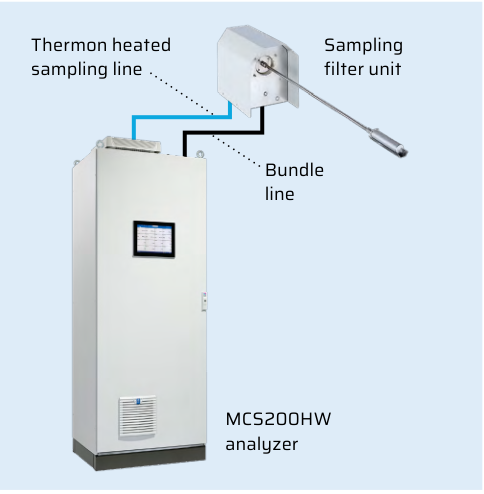
As the sample travels through the probe, tubing and fittings, its temperature must remain above the relevant dew point. If it cools sufficiently, moisture and other condensable constituents can form liquids within the line. Reactions can also produce sticky acid salts that contaminate the sample path, restrict flow and increase maintenance. More importantly, the gas reaching the analyzer may no longer accurately represent the gas originally extracted from the process.
MCS200HW: Keeping the Complete Sample Path Hot
The Endress+Hauser MCS200HW is a compact, heated system designed for continuous flue-gas analysis. The heated design complements the TubeTrace sample line by maintaining sample conditions through the measurement system.
The MCS200HW can also be supplied in a weatherproof enclosure with a pre-connected Monitoring Box for monitoring analyzer health. Combined with temperature monitoring in the TubeTrace bundle, operators gain greater visibility into both the analyzer and the condition of the sample transport system.
Another important design feature is the MCS200HW’s use of an ejector operating on the Venturi principle for sample transport rather than a conventional mechanical sample pump. Instrument air creates the pressure differential needed to move the sample. Eliminating a conventional sample pump removes a component with moving and wear parts that can require periodic servicing. Combined with a properly heated sample line, this design can simplify routine maintenance and contribute to higher analyzer availability.
Why Heated Tubing Bundles Matter
Heated tubing bundles address this risk by combining sample tubing, electric heat tracing and thermal insulation into a single engineered assembly. Their purpose is not simply to transport gas, but to maintain the sample within the required temperature range over the entire distance between the stack and analyzer.
Properly designed heated bundles can help:
- Prevent condensation and acid salt formation
- Preserve reactive and water-soluble gas components
- Reduce plugging and contamination
- Maintain stable sample flow
- Support consistent analyzer response
- Reduce sample-system maintenance
- Improve overall CEMS availability
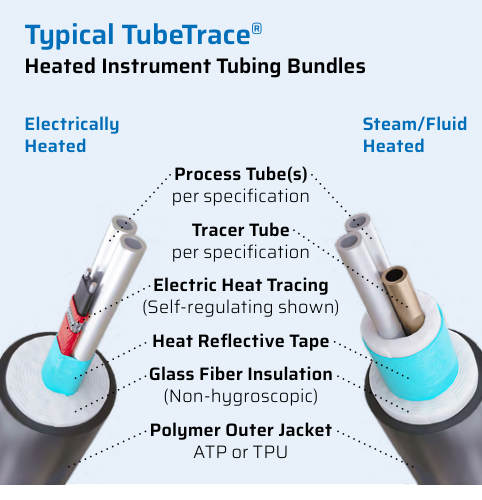
These considerations become increasingly important with longer sample runs and severe ambient conditions. In Western Canada’s winter climate, exposed sample lines can experience substantial heat loss. Heat-trace output, insulation and bundle construction therefore need to be selected for the actual installation conditions.
Tubing Material Matters Too
Temperature is only one part of sample preservation. The material contacting the gas can also influence measurement quality.
For applications involving reactive, corrosive or low-level constituents, SilcoNert®-treated tubing can help reduce adsorption and unwanted interaction between the gas and internal tubing surface. This can help difficult-to-measure compounds reach the analyzer with less loss or alteration, particularly where low concentrations or rapid response are important.
Tubing Materials and Finishes
- 316 and 304 Stainless, Monel, titanium, and Alloy 825
- Optional Electropolished (EP) finishes and chemical passivation (CP), (including SilcoNert1000, SilcoNert2000, and Dursan)
- Double containment tubing and/or multiple tube materials in a common bundle
- Fluoropolymer tubing (including PFA, TFE, and FEP) nylon, polyethylene, composite filament-wound tubing and most any other tubing material is also available
To learn more or request a quote, contact us today at sales@intrepid-group.ca.