Flare headers operate across an exceptionally wide range of conditions. During normal operation, flow may be limited to purge gas or relatively small quantities of routine flare gas. Within seconds, however, a process upset or emergency can send dramatically higher volumes through the same header. Gas compositions may change drastically based on the flaring event. A useful flare flowmeter must do more than measure accurately at one operating point. It must capture both the low-end flowrates and high-end flowrates accurately enough to report on.
One Meter for a Highly Dynamic Application
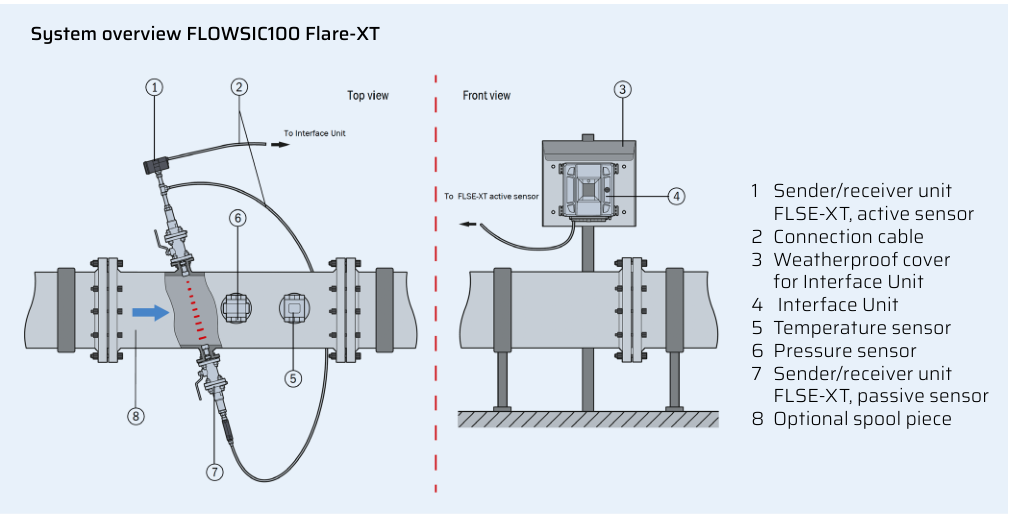
The FLOWSIC100 Flare-XT was designed specifically around this challenge. Endress+Hauser identifies flare applications as having velocities ranging from approximately 0 to 120 m/s (400 ft/s) or higher, together with rapid velocity changes, changing gas mixtures, and wet or dirty conditions.
FLOWSIC100 Flare-XT
Measurement availability under all operating conditions, at high gas velocities and with changing gas compositions
- Individual application evaluation
- i-diagnostics™ for self monitoring, easy verification and condition-based maintenance of the system
- Retrofit solutions for existing measurement systems
The greater challenge comes when an upset suddenly accelerates the gas. At extreme velocities, conventional ultrasonic signals can become increasingly difficult to detect. Flare-XT addresses this with Active Sound Correlation (ASC). ASC uses application-specific noise generated by the high-velocity gas to determine velocity, extending the upper measurement range by up to 30%.
Why Thermal Mass Technology can Struggle in Flare Service
Wide velocity range is only part of the challenge. The composition of waste gas entering a common flare header can also change significantly.
Thermal mass meters determine flow from heat transfer between a heated sensor and the process gas. Because heat transfer depends on the thermal properties of the gas, measurement performance is influenced by gas composition. A meter configured for a relatively stable mixture can therefore experience additional uncertainty when flare gas composition changes.
This is particularly relevant when gases from different process units enter a common flare header. Hydrocarbons, hydrogen, nitrogen and other components may vary considerably between routine operation and an upset. Rapid velocity changes, wet gas and contamination can further complicate thermal measurement.
FLOWSIC100 Flare-XT takes a different approach. Its ultrasonic measurement is specifically designed for changing flare-gas compositions and extreme velocity ranges.
Key Takeaways
- FLOWSIC100 Flare-XT is purpose-built for flare service, measuring velocities from approximately 0.03 to 120 m/s while accommodating rapidly changing operating conditions.
- Active Sound Correlation (ASC) helps maintain measurement during extreme high-velocity events where conventional ultrasonic signals become difficult to detect.
- Changing gas composition matters. Ultrasonic technology avoids many of the composition-related limitations that can affect thermal mass meters in variable flare gas streams.
- Better flare data can save money. More accurate differentiation between purge gas and hydrocarbon flare gas supports defensible emissions reporting and can help reduce unnecessary carbon-related costs.
To learn more or request a quote, contact us today at sales@intrepid-group.ca.